
Faribault County District Court Overview
Faribault County District Court is the general-jurisdiction trial court for the county. The official court page states that it has original jurisdiction over civil, family, probate, juvenile, criminal, and traffic cases filed in Faribault County. The court is located at the Faribault County Courthouse, 415 North Main Street, Blue Earth, Minnesota 56013.
Court Administrator Tammy Bauman leads local Court Administration. The court phone is (507) 526-6273, fax is 507-618-5869, and business hours are Monday through Friday, 8:00 a.m. to 4:30 p.m. The courthouse page states that on-street parking is available. The county's main mailing address is 415 N Main Street, P.O. Box 130, Blue Earth, MN 56013.
Faribault County is in Minnesota's Fifth Judicial District, a southwest Minnesota administrative district. The district administration office oversees district courts in 15 counties but does not hear county cases itself.
List of Faribault County District Courts
There is one local District Court serving Faribault County. Civil, family, probate, juvenile, criminal, traffic, and conciliation case types are handled through this court rather than through separate county, municipal, or justice courts.
| Court | Case types | Address | Phone |
|---|---|---|---|
| Faribault County District Court | Civil, family, probate, juvenile, criminal, traffic, conciliation | 415 North Main Street, Blue Earth, MN 56013 | (507) 526-6273 |
| Faribault County Court Administration | Case questions, calendar questions, copy requests, certified copies | Same courthouse | (507) 526-6273 |
District Court vs. County Court vs. Justice Court
Minnesota's official structure is different from states that divide cases among county courts, justice of the peace courts, or municipal courts. Faribault County has District Court as its trial court, and official research did not identify lower local courts that hold separate criminal or traffic records for the county.
| Faribault County District Court | County Court | Justice / JP Court | |
|---|---|---|---|
| Local status | Official Minnesota trial court for Faribault County | Not a separate Faribault County court in the researched Minnesota structure | Not a Faribault County court channel in the researched Minnesota structure |
| Civil cases | Civil actions, conciliation, judgments, family, probate | No separate local channel documented | No separate local channel documented |
| Criminal and traffic cases | Criminal, traffic, petty, and citation matters filed in District Court | No separate local channel documented | No separate local channel documented |
| Records access | MCRO, court calendar, courthouse terminals, Court Administration | Not applicable from the research map | Not applicable from the research map |
How a Case Moves Through the Faribault County System
Cases begin in Faribault County District Court when a complaint, petition, citation, probate filing, family filing, juvenile matter, or other first paper is filed. MCRO and the local calendar can show case numbers, hearing dates, hearing types, judicial officers, and public documents when remote-access rules allow. Certified copies and official records come from Court Administration.
Criminal and traffic flow: Citation or complaint › initial appearance or arraignment › pretrial or omnibus hearing › plea, trial, dismissal, or other disposition › sentencing or payment/enforcement › appeal when allowed.
Civil and family flow: First paper filed › service and response › motions or case management › hearing, settlement, trial, or order › judgment or final decree › appeal when allowed.
Probate flow: Estate, trust, guardianship, conservatorship, or probate petition › fee or waiver › hearing if required › appointment, letters, orders, inventory/accounting events, and certified copies as needed.
Civil, Family, Probate, Juvenile, Criminal, and Traffic Cases
Faribault County District Court handles broad case categories in one local trial court. Civil cases may include complaints, motions, judgments, satisfaction documents, eviction-style actions, conciliation matters, and name changes. Criminal cases include complaints, charges, hearings, pleas, orders, sentencing, and probation violation filings. Family cases include dissolution, custody, paternity, parenting time, child support, orders for protection, and harassment matters, although some family and protective-order documents have remote-access limits.
Probate cases include estate, formal probate, other probate, guardianship, conservatorship, and trust matters. Juvenile delinquency and child protection records are more restricted. Traffic and petty misdemeanor matters can be searched by citation number or case number, and payable citations may route through Minnesota Court Web Payment.
Fifth Judicial District
The Fifth Judicial District includes Blue Earth, Brown, Cottonwood, Faribault, Jackson, Lincoln, Lyon, Martin, Murray, Nicollet, Nobles, Pipestone, Redwood, Rock, and Watonwan Counties. The district page says Minnesota was divided into 10 judicial districts for administrative purposes effective July 1, 1959, under Minn. Stat. 2.722. The Fifth District has 17 judges serving about 287,000 citizens, and judges are elected for six-year terms. District Administrator Michael J. Kelley and Deputy District Administrator Sonja Kruger are listed in the research.
The official treatment court county-specific information page lists Southern Prairie Treatment Court programs serving the Faribault, Martin, and Jackson area.
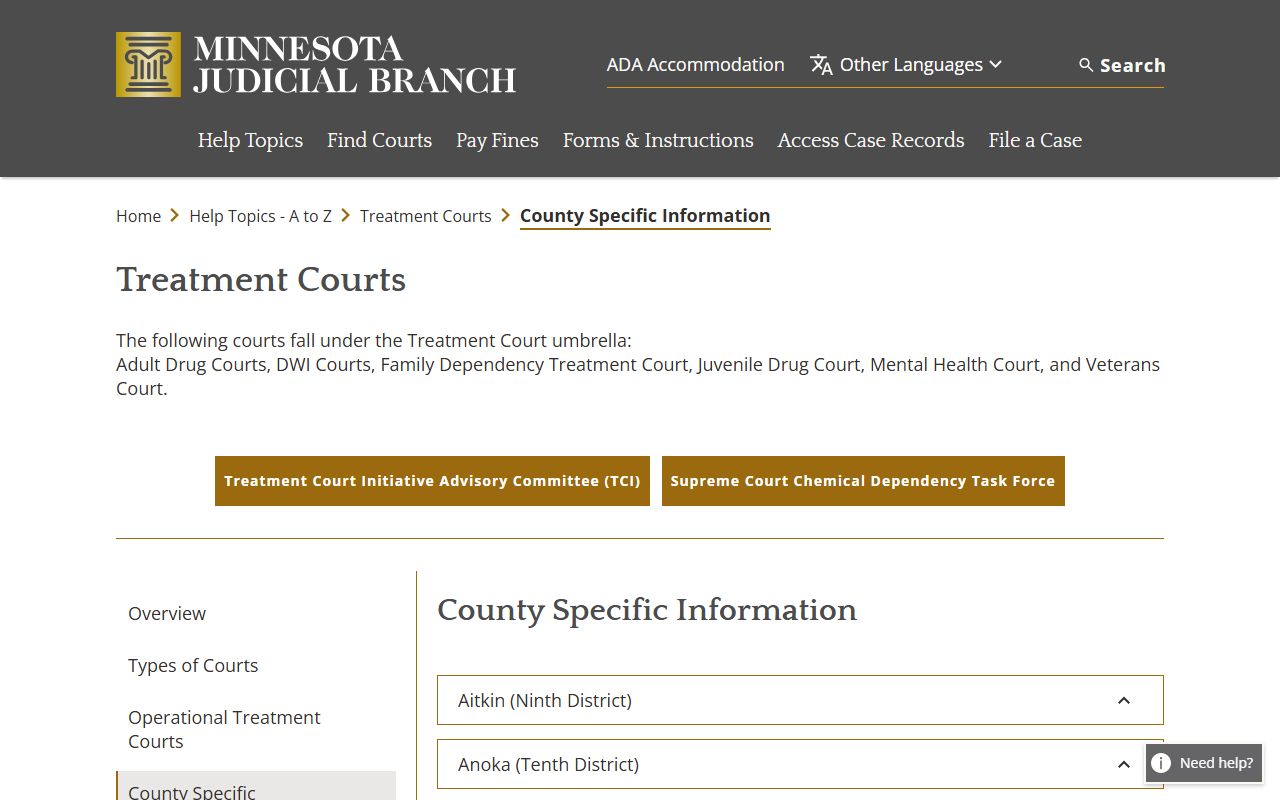
Those programs are regional, not separate Faribault County trial courts. They serve eligible case participants through a problem-solving court model tied to District Court supervision.
The Judicial Branch operational treatment courts overview explains the broader treatment court categories used in Minnesota.
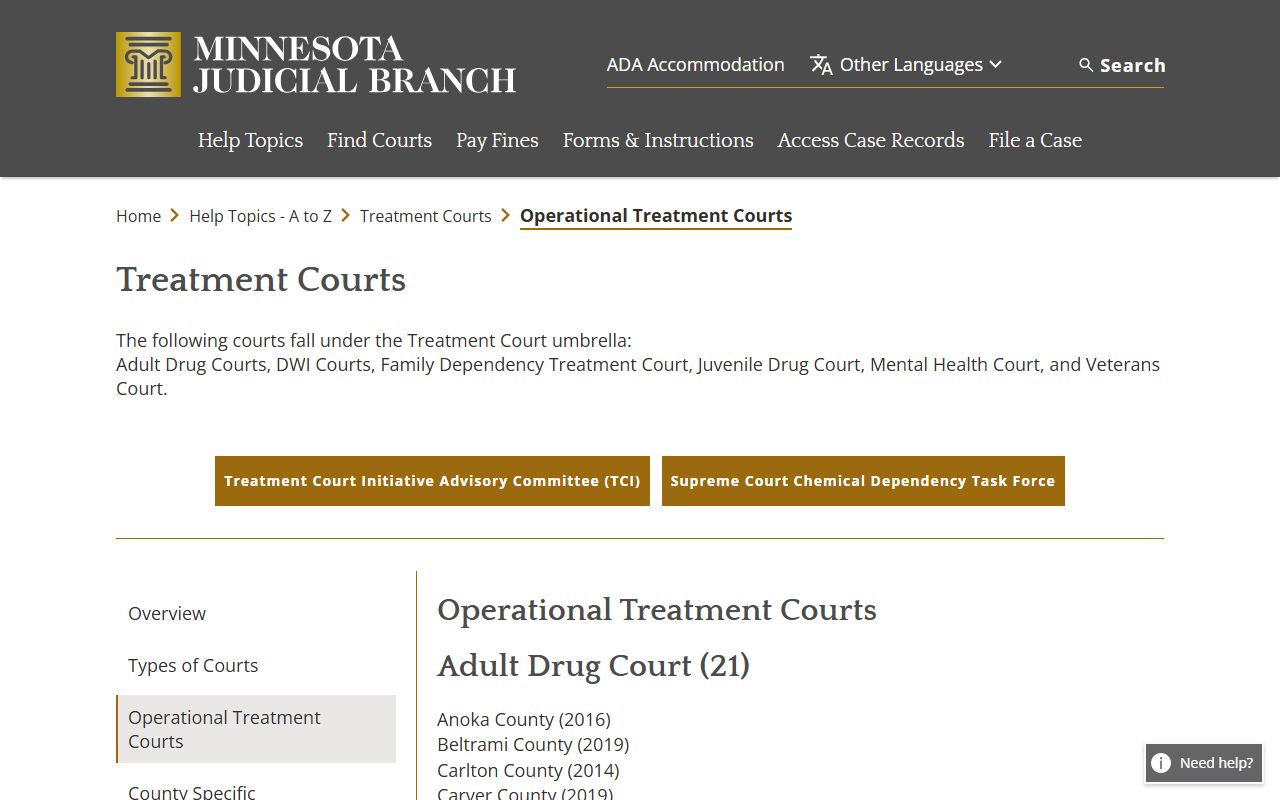
The Faribault-Martin-Jackson Adult Drug Court and Family Dependency Treatment Court are examples of these multi-county programs.
Minnesota Court Hierarchy
Minnesota has three main state-court levels: District Court, Court of Appeals, and Supreme Court. Faribault County District Court is the trial court. Appeals from final District Court decisions generally go to the Minnesota Court of Appeals, which acts as the intermediate error-correcting court for final trial-court, agency, and local-government decisions. Further review may be sought in the Minnesota Supreme Court depending on case type and appellate rules.
| Court or office | Role | Record path |
|---|---|---|
| Faribault County District Court | Trial court for local state cases | MCRO, court calendar, Court Administration |
| Fifth Judicial District Administration | Administrative district for 15 southwest Minnesota counties | Use local District Court for case records |
| Minnesota Court of Appeals | Intermediate appellate review | State appellate records, not local District Court copies |
| Minnesota Supreme Court | Highest state court and discretionary review | State appellate records |
Court Calendar, Remote Access, and eCheck-in
The Faribault County District Court page links to a daily or weekly public calendar PDF. The research found that the calendar is posted at 7:00 a.m. each business day and updated hourly according to the court page. Calendar entries can show party name, hearing location, hearing date, time, judicial officer, hearing type, party role, and case number. Confidential cases and cases not remotely accessible under Minnesota public-access rules are not posted, and the court warns that absence from the calendar does not prove a hearing was cancelled or rescheduled.
The court page also documents modern access features such as Zoom and eCheck-in. Users should follow the court's direct instructions for remote appearances, hearing confirmation, and arrival requirements because local court calendars and hearing links can change.
Faribault County Courthouse History
Faribault County's court history is tied closely to the courthouse block in Blue Earth. The official history says the county's first court cases were held in the parlor of a local residence. In the mid-1860s, the Wakefield family sold an entire city block to the county for $1.50 on the condition that a courthouse be built. The first brick courthouse opened in 1872, and the current courthouse replaced it on the same site in 1892.
The current courthouse includes Kasota quarry stone, Blue Earth River sand, red brick, rusticated limestone, a clay tile roof, terra cotta decoration, granite columns, Syrian arches, foliated capitals, golden oak woodwork, etched office glass, stained-glass transoms, and a seven-story corner tower. A west wing was added in 1974, and the courthouse was placed on the National Register of Historic Places in 1977.
Federal Courts Are Separate
Some Faribault County residents may need federal records, but those are not Faribault County District Court records. Federal civil and criminal cases route to the U.S. District Court for the District of Minnesota. Bankruptcy cases route to the U.S. Bankruptcy Court for the District of Minnesota. Federal records are searched through PACER and federal CM/ECF systems.
The official U.S. District Court for the District of Minnesota website is separate from Minnesota District Court.
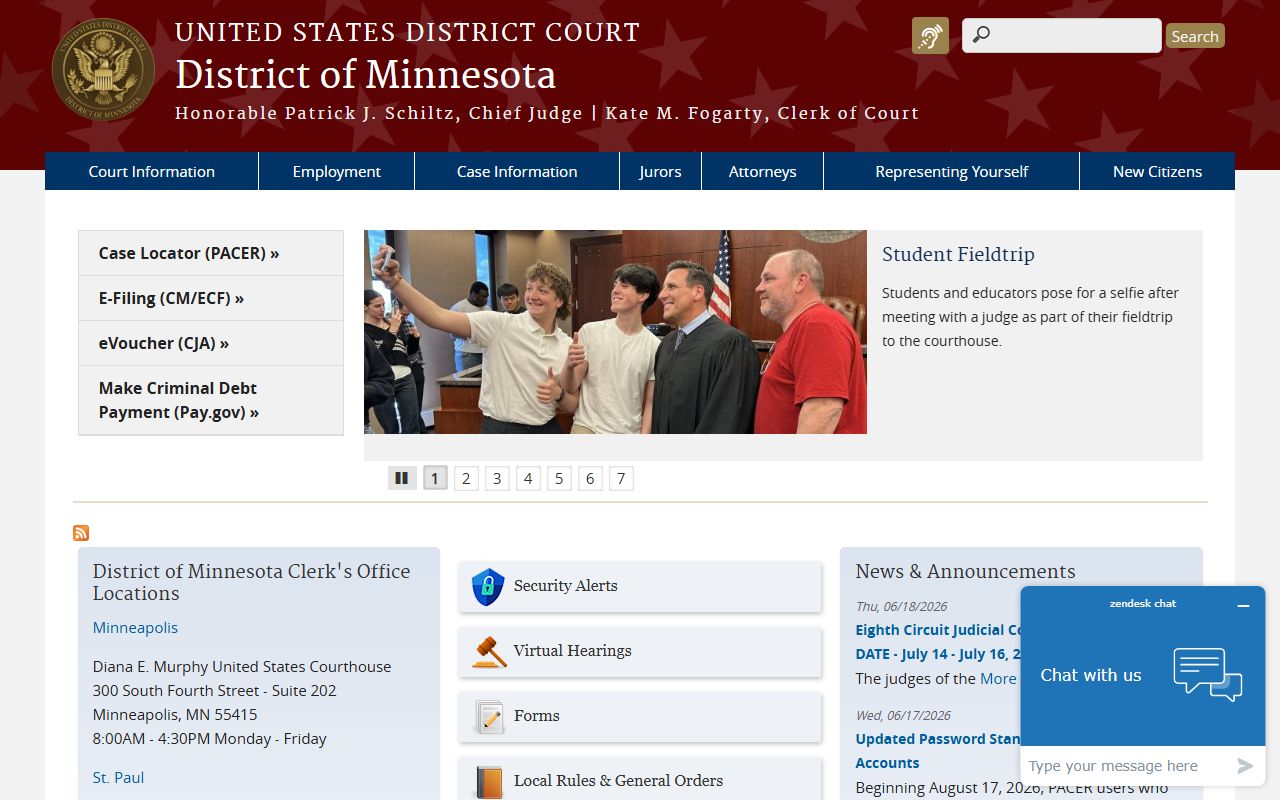
Use that federal site for federal court locations, rules, and filings, not for Faribault County state case copies.
The federal court's contact information page lists federal courthouse contacts and hours.
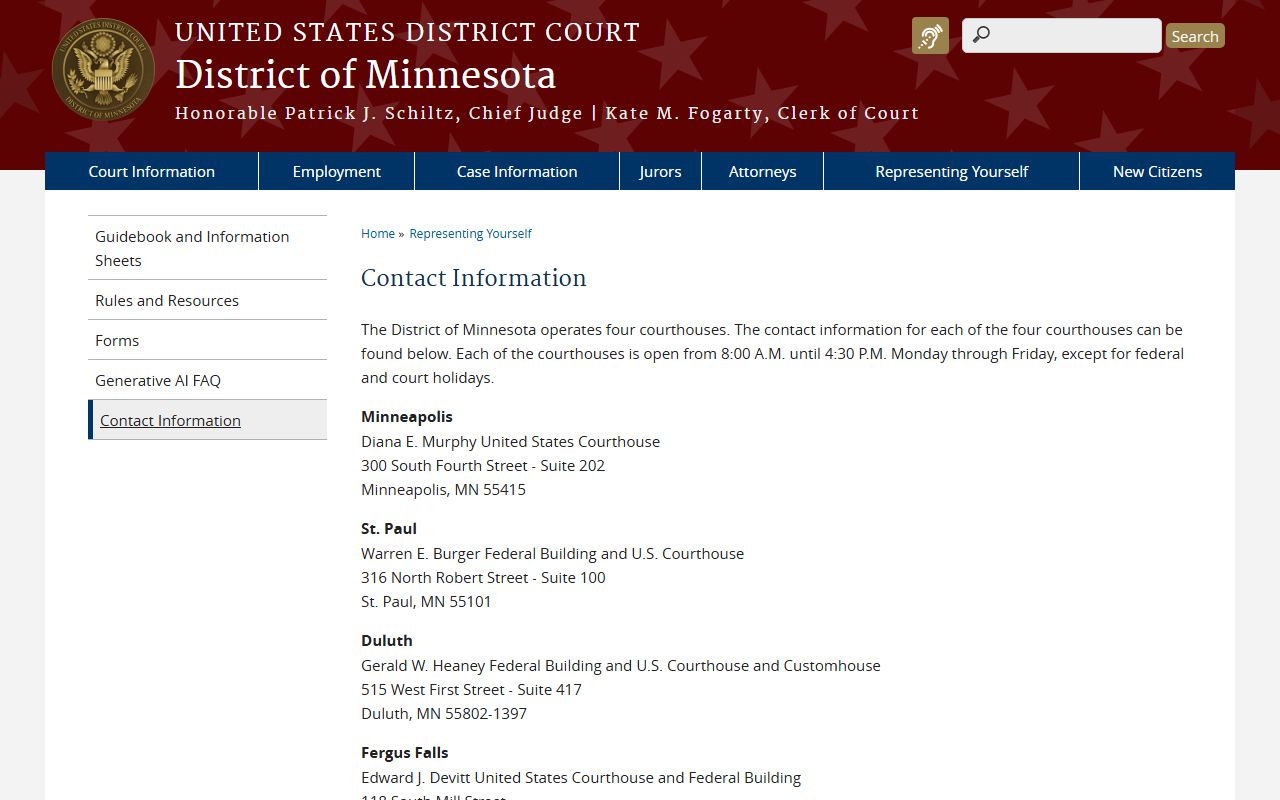
When a federal case number is known, PACER court lookup and CM/ECF provide the electronic record path.
The PACER Minnesota District Court entry identifies the federal District of Minnesota court entry.
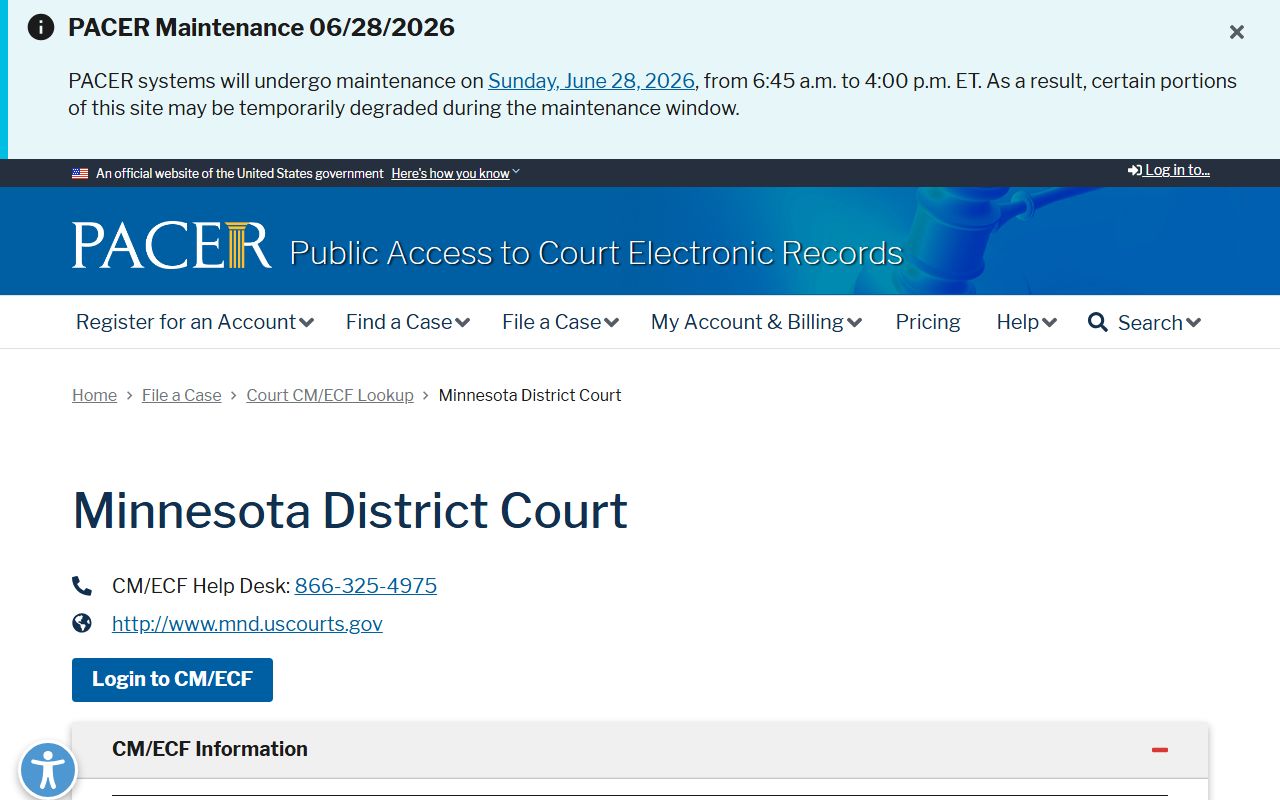
That PACER entry is a federal access point, while MCRO remains the state District Court search system for Faribault County.
The District of Minnesota CM/ECF system is another federal filing and records channel.
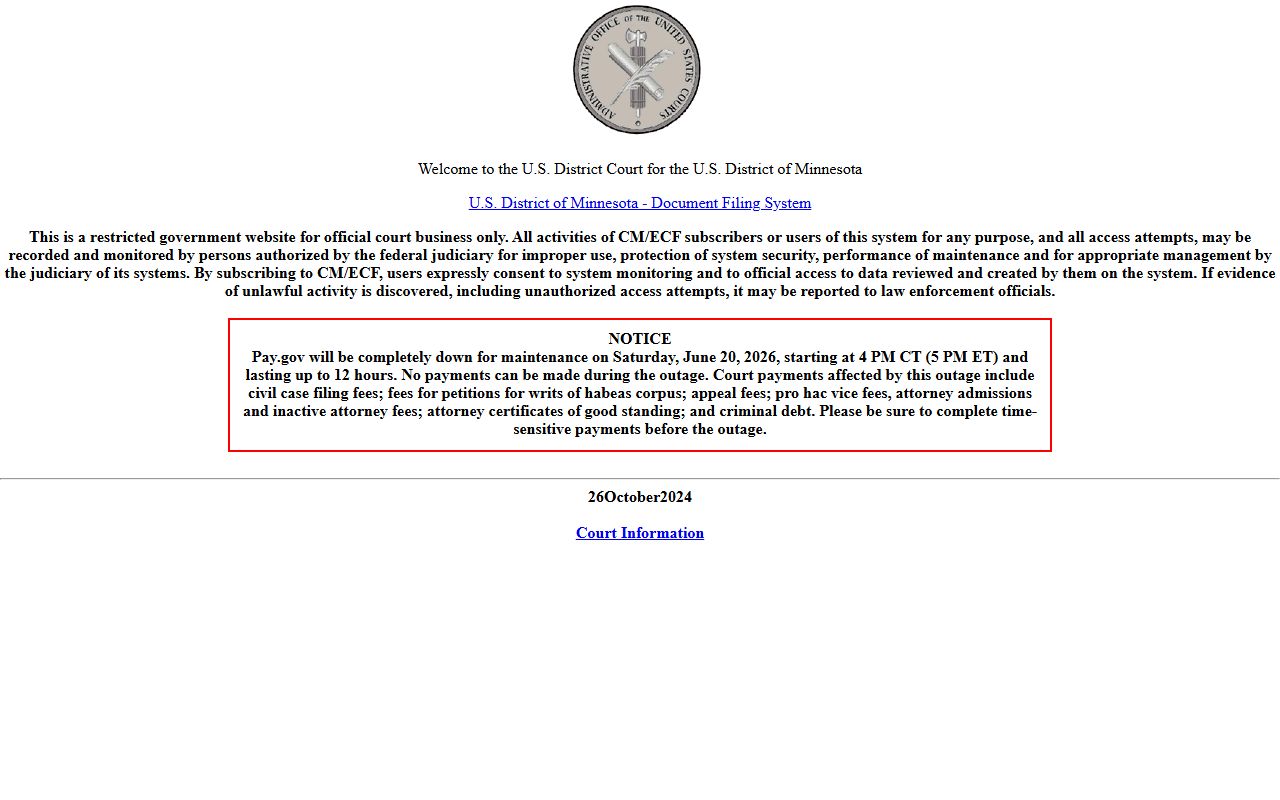
Faribault County Court Administration cannot certify federal filings; federal certified copies must come through the appropriate federal court process.